
Gate-Error Modelling of Microwave-over-Fiber Drive Links for Superconducting Qubits Under Cryogenic Heat Constraints
DOI:
https://doi.org/10.58564/IJCCN.2.3.2026.23Keywords:
Microwave photonics, Analog optical link, Superconducting qubit, Shot noise, Cryogenic heat loadAbstract
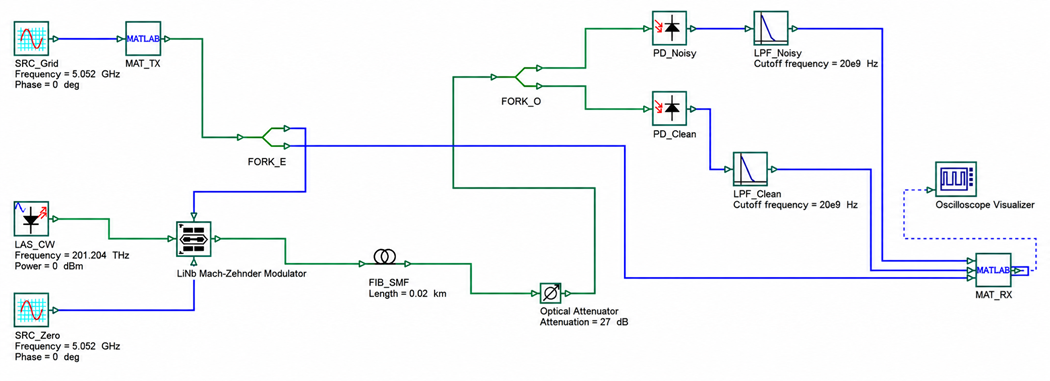
Analog microwave-over-fiber (MoF) links can deliver qubit-control signals to a cryogenic photodiode with a much lower passive heat load than coaxial wiring. However, the required photocurrent dissipates heat at the cold stage, and its shot noise perturbs the qubit. This paper develops a physics-structured model that maps the Mach–Zehnder modulator (MZM) bias, the modulation depth, the photocurrent scale, and the gate duration of an analog MoF link to the link-induced average infidelity of a transmon gate. The model is then used to design links that minimize idle optical heat. The optical link was simulated in OptiSystem software, and the received photocurrents drove a three-level transmon model with Lindblad decoherence in MATLAB. Across 1344 simulation runs covering 15–45 dB of optical attenuation, bias angles of 90°–170°, modulation indices of 0.2–1.3, and gate durations of 20 and 40 ns, deterministic link distortion contributed an infidelity of at most , the link-induced error scaled as , and leakage accounted for about 60% of it. The closed-form model, which includes pulse-induced shot noise and Bessel-function drive compression and has a single calibrated coefficient, predicted held-out low-power and low-bias configurations with a logarithmic root-mean-square error of 0.040 decades, compared with 0.155–0.412 decades for three reference models. Six operating points designed with the frozen model met their pre-registered error targets to within 8.5% in new simulations and required 9.1–11.1 times less idle optical power at the photodiode than the best quadrature-biased design.
References
[1] F. Lecocq, F. Quinlan, K. Cicak, J. Aumentado, S. A. Diddams, and J. D. Teufel, “Control and readout of a superconducting qubit using a photonic link,” Nature, vol. 591, no. 7851, pp. 575–579, 2021, doi: 10.1038/s41586-021-03268-x.
[2] J. Capmany and D. Novak, “Microwave photonics combines two worlds,” Nature Photonics, vol. 1, no. 6, pp. 319–330, 2007, doi: 10.1038/nphoton.2007.89.
[3] T. Nakamura, D. Lee, J. Horng, F. Lecocq, J. Teufel, and F. Quinlan, “Cryogenic photonic link using an extended-InGaAs photodiode and short pulse illumination toward high-fidelity drive of superconducting qubits,” Optica Quantum, vol. 3, no. 3, pp. 221–227, 2025, doi: 10.1364/OPTICAQ.546795.
[4] H. K. Warner, J. Holzgrafe, B. Yankelevich, D. Barton, S. Poletto, C. J. Xin, N. Sinclair, D. Zhu, E. Sete, B. Langley, E. Batson, M. Colangelo, A. Shams-Ansari, G. Joe, K. K. Berggren, L. Jiang, M. J. Reagor, and M. Lončar, “Coherent control of a superconducting qubit using light,” Nature Physics, vol. 21, pp. 831–838, 2025, doi: 10.1038/s41567-025-02812-0.
[5] G. Arnold, T. Werner, R. Sahu, L. N. Kapoor, L. Qiu, and J. M. Fink, “All-optical superconducting qubit readout,” Nature Physics, vol. 21, pp. 393–400, 2025, doi: 10.1038/s41567-024-02741-4.
[6] J. P. G. van Dijk, E. Kawakami, R. N. Schouten, M. Veldhorst, L. M. K. Vandersypen, M. Babaie, E. Charbon, and F. Sebastiano, “Impact of classical control electronics on qubit fidelity,” Physical Review Applied, vol. 12, no. 4, Art. no. 044054, 2019, doi: 10.1103/PhysRevApplied.12.044054.
[7] H. Ball, W. D. Oliver, and M. J. Biercuk, “The role of master clock stability in quantum information processing,” npj Quantum Information, vol. 2, Art. no. 16033, 2016, doi: 10.1038/npjqi.2016.33.
[8] C. H. Cox, E. I. Ackerman, G. E. Betts, and J. L. Prince, “Limits on the performance of RF-over-fiber links and their impact on device design,” IEEE Transactions on Microwave Theory and Techniques, vol. 54, no. 2, pp. 906–920, 2006, doi: 10.1109/TMTT.2005.863818.
[9] J. Koch, T. M. Yu, J. Gambetta, A. A. Houck, D. I. Schuster, J. Majer, A. Blais, M. H. Devoret, S. M. Girvin, and R. J. Schoelkopf, “Charge-insensitive qubit design derived from the Cooper pair box,” Physical Review A, vol. 76, no. 4, Art. no. 042319, 2007, doi: 10.1103/PhysRevA.76.042319.
[10] F. Motzoi, J. M. Gambetta, P. Rebentrost, and F. K. Wilhelm, “Simple pulses for elimination of leakage in weakly nonlinear qubits,” Physical Review Letters, vol. 103, no. 11, Art. no. 110501, 2009, doi: 10.1103/PhysRevLett.103.110501.
[11] S. Blanes, F. Casas, J. A. Oteo, and J. Ros, “The Magnus expansion and some of its applications,” Physics Reports, vol. 470, no. 5–6, pp. 151–238, 2009, doi: 10.1016/j.physrep.2008.11.001.
[12] G. Lindblad, “On the generators of quantum dynamical semigroups,” Communications in Mathematical Physics, vol. 48, no. 2, pp. 119–130, 1976, doi: 10.1007/BF01608499.
[13] M. A. Nielsen, “A simple formula for the average gate fidelity of a quantum dynamical operation,” Physics Letters A, vol. 303, no. 4, pp. 249–252, 2002, doi: 10.1016/S0375-9601(02)01272-0.
[14] L. H. Pedersen, N. M. Møller, and K. Mølmer, “Fidelity of quantum operations,” Physics Letters A, vol. 367, no. 1–2, pp. 47–51, 2007, doi: 10.1016/j.physleta.2007.02.069.
[15] J. H. Friedman, “Greedy function approximation: A gradient boosting machine,” The Annals of Statistics, vol. 29, no. 5, pp. 1189–1232, 2001, doi: 10.1214/aos/1013203451.
[16] B. Efron, “Bootstrap methods: Another look at the jackknife,” The Annals of Statistics, vol. 7, no. 1, pp. 1–26, 1979, doi: 10.1214/aos/1176344552.
Downloads
Published
How to Cite
Issue
Section
License
Copyright (c) 2026 Suhail Najm Abdullah

This work is licensed under a Creative Commons Attribution 4.0 International License.

