
Optical Wireless Communication System for Monitoring Underwater Floods and Water Quality
DOI:
https://doi.org/10.58564/IJCCN.2.2.2026.20Keywords:
Underwater Optical Wireless Communication, Water Quality, Flooding, real-time monitoring and controlAbstract
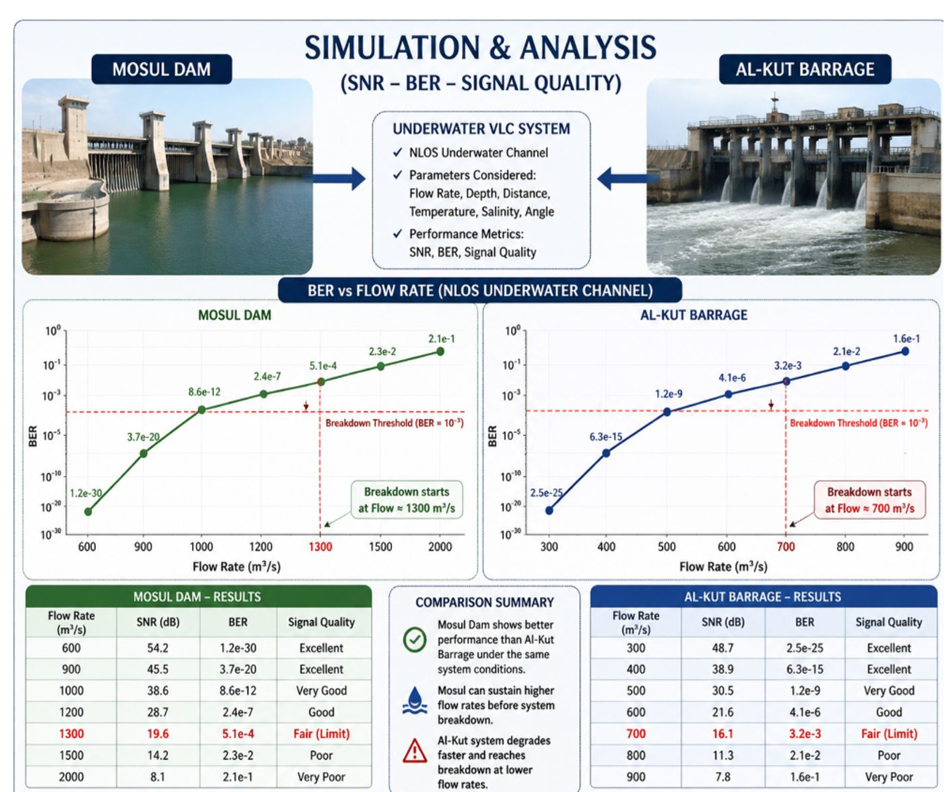
An improved model for a UOWC system with real-time flood and water quality monitoring is implemented, taking into account the Arduino sensor modules, along with high precision of the optical channel simulation models developed with Opti and MATLAB environments, with the support of parameters like water turbidity, depth, temperature, transmission angle, reception angle, horizontal distance of transmission, and transmission angle and distance. Operating limits for the system were defined under various aquatic conditions and in different water environments. Key communication parameters, including signal-to-noise ratio (SNR) and bit error rate (BER), were analyzed. The results showed that the system is effective for use in different aquatic environments to detect floods and monitor environmental parameters and their changes in real time within defined operating limits. A graphical user interface was developed using MATLAB App Designer to ensure real-time monitoring and control, making the system suitable for intelligent underwater and flood monitoring applications.
References
[1] E. Herrfahrdt-Pähle et al., “Empowering global water governance: taking the 2023 UN Water Conference outcomes forward to address the current water crises,” Water Int., vol. 50, no. 1, pp. 4–10, 2025.
[2] W. Shih, “The World Bank and climate change,” J. Int. Econ. Law, vol. 3, no. 4, pp. 633–653, 2000.
[3] K. Smith, C. J. Fearnley, D. Dixon, D. K. Bird, and I. Kelman, Environmental hazards: assessing risk and reducing disaster. Routledge, 2023.
[4] M. Tonnelier et al., “What makes an epidemic a disaster: the future of epidemics within the EM-DAT International Disaster Database,” BMC Public Health, vol. 25, no. 1, p. 21, 2025.
[5] T. S. Rappaport, A. Annamalai, R. M. Buehrer, and W. H. Tranter, “Wireless communications: Past events and a future perspective,” IEEE Commun. Mag., vol. 40, no. 5, pp. 148–161, 2002.
[6] M. Stojanovic and J. Preisig, “Underwater acoustic communication channels: Propagation models and statistical characterization,” IEEE Commun. Mag., vol. 47, no. 1, pp. 84–89, 2009.
[7] Z. Ghassemlooy et al., “An overview of optical wireless communications,” Opt. Wirel. Commun. An Emerg. Technol., pp. 1–23, 2016.
[8] H. A. SATEA, “IMPROVING THE HYBRID FSO/LI-FI/UWOC NETWORK’S,” Int. J., vol. 14, no. 1, pp. 21–29, 2025.
[9] S. H. Alnajjar, A. R. Alabbas, and M. J. Ahmad, “Effective Signal Transmission from Underwater to Air Utilizing Hybrid Communication Systems.,” J. Intell. Syst. Internet Things, vol. 16, no. 2, 2025.
[10] S. Jaruwatanadilok, “Underwater wireless optical communication channel modeling and performance evaluation using vector radiative transfer theory,” IEEE J. Sel. areas Commun., vol. 26, no. 9, pp. 1620–1627, 2008.
[11] N. Payal and D. Gurjar, “Hybrid FSO/RF and UWOC system for enabling terrestrial-underwater communication: Performance analysis,” Phys. Commun., vol. 68, p. 102540, Nov. 2024, doi: 10.1016/j.phycom.2024.102540.
[12] P. Shamsudheen, E. Sureshkumar, and J. Chunkath, “Performance Analysis of Visible Light Communication System for Free Space Optical Communication Link,” Procedia Technol., vol. 24, pp. 827–833, 2016, doi: https://doi.org/10.1016/j.protcy.2016.05.116.
[13] S. H. Alnajjar, M. K. Al-obaidi, M. J. Ahmad, and B. M. Albaker, “Hybrid Terrestrial-Underwater Optical Communications Link,” Diyala J. Eng. Sci., pp. 133–143, 2025.
[14] K. Zhang et al., “Turbidity-tolerant underwater wireless optical communications using dense blue–green wavelength division multiplexing,” Opt. Express, vol. 32, no. 12, pp. 20762–20775, 2024.
[15] S. Arnon, Underwater Optical Wireless Communication. 2015.
Downloads
Published
How to Cite
Issue
Section
License
Copyright (c) 2026 Zahraa Hassan, Satea H. Alnajjar

This work is licensed under a Creative Commons Attribution 4.0 International License.

